
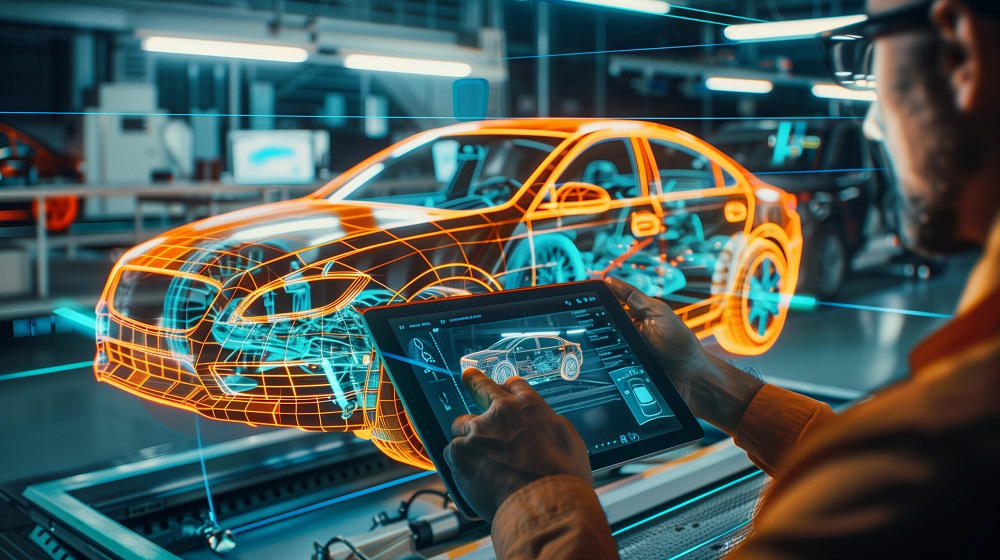
The automotive industry is undergoing its most profound transformation since the introduction of the moving assembly line. While traditional vehicle manufacturing focused primarily on mechanical engineering, thermodynamics, and aerodynamics, the modern automotive landscape is increasingly defined by software engineering, data science, and computational power. At the center of this paradigm shift is artificial intelligence.
AI is no longer just a futuristic concept confined to the development of self-driving prototypes. Today, machine learning, neural networks, and generative AI are deeply integrated into every stage of the automotive lifecycle. From initial concept design and crash-test simulations to supply chain management, factory-floor robotics, and real-time vehicle diagnostics, AI is dramatically accelerating development timelines, lowering production costs, and reshaping the relationship between drivers and their vehicles.
Accelerating vehicle Design and Advanced Simulation
The traditional timeline for developing a new vehicle from initial sketch to production ready model historically took anywhere from five to seven years. A significant portion of this time was consumed by building physical prototypes, conducting wind-tunnel testing, and executing destructive crash tests. Artificial intelligence has fundamentally compressed this timeline.
Generative AI in Styling and Aerodynamics
Automotive designers are increasingly utilizing generative AI algorithms to explore thousands of design permutations in a matter of hours. By inputting structural parameters, weight limitations, and regulatory safety requirements, engineers can use AI to generate highly optimized component geometries that a human designer might never conceive.
This is particularly useful in structural weight reduction for electric vehicles, where minimizing mass directly correlates to increased battery range. Furthermore, AI-driven computational fluid dynamics tools can accurately predict a vehicle’s aerodynamic drag coefficient in a virtual environment, reducing the need for costly and time-consuming physical wind-tunnel modeling.
High Fidelity Virtual Crash Testing
Before a vehicle can be certified for the public market, it must undergo rigorous safety evaluations. Historically, this meant physically destroying dozens of multimillion-dollar pre-production vehicles.
Today, advanced machine learning models simulate crash scenarios with microscopic precision. These AI systems analyze how complex metal alloys, carbon fibers, and welds deform under structural stress at various impact angles. By accurately predicting component failure points virtually, engineers can make rapid, iterative adjustments to the vehicle’s crumple zones and safety cells long before a physical prototype is built.
Optimizing Smart Manufacturing and Supply Chain Logistics
The impact of artificial intelligence extends far beyond the engineering lab and directly onto the factory floor, transforming automotive plants into highly autonomous smart facilities.
Predictive Maintenance on the Assembly Line
Unscheduled downtime in an automotive manufacturing plant can cost companies tens of thousands of dollars per minute. To combat this, manufacturers deploy AI-driven predictive maintenance systems across the assembly line.
Sensors attached to heavy stamping presses, robotic welding arms, and paint-spraying booths continuously monitor variables such as vibration, temperature, acoustic frequencies, and power consumption. Machine learning algorithms analyze this real-time telemetry data to detect subtle anomalies that indicate impending mechanical failure, allowing maintenance teams to service equipment proactively during scheduled weekend shifts.
Computer Vision for Real Time Quality Control
Human inspection, while vital, is susceptible to fatigue and oversight, especially in high-volume production facilities. Advanced computer vision systems powered by deep learning neural networks are now installed at critical points along the assembly line.
These high-speed cameras photograph every millimeter of a vehicle as it progresses. The AI instantly compares these images against a perfect digital master blueprint, detecting micro-defects such as paint blemishes, misaligned body panels, improper weld points, or loose electrical connectors that are completely invisible to the naked eye. This ensures that every vehicle leaving the factory meets strict quality control standards.
The Evolution of Advanced Driver Assistance Systems and Autonomous Driving
The most widely discussed application of artificial intelligence in the automotive sector is its role in enabling vehicles to perceive, interpret, and navigate their surroundings without human intervention.
Sensor Fusion and Real Time Perception
For a vehicle to achieve any level of autonomous operation, it must process vast amounts of data streaming from an array of onboard sensors, including radar, lidar, ultrasound, and high-resolution cameras. This process is known as sensor fusion.
Artificial intelligence acts as the central cognitive brain that synthesizes this fragmented data in real time. Deep learning algorithms categorize objects in milliseconds, distinguishing a pedestrian stepping off a curb from a harmless cardboard box blowing across the highway. The AI must also calculate the vector velocities of surrounding vehicles, predicting their pathing to make safe lane-change and braking decisions.
Edge Computing and Continuous Fleet Learning
Modern autonomous vehicle development relies heavily on fleet learning. When an AI-guided vehicle encounters an unusual or ambiguous scenario on the road, such as an undocumented construction zone or erratic animal behavior, the onboard edge-computing system logs the data.
This edge case information is uploaded to a centralized cloud server, where it is used to retrain the core machine learning models. The updated, highly refined neural network is then pushed back out to the entire global fleet of vehicles via over-the-air software updates, ensuring that every car continuously learns from the collective experiences of every other vehicle on the road.
Frequently Asked Questions
What is the difference between Level 2 and Level 5 autonomous vehicles in relation to AI usage?
The Society of Automotive Engineers defines automated driving through six distinct levels. Level 2 vehicles, which are common in the modern market, use AI for partial automation, such as lane-keeping assistance and adaptive cruise control, but require the human driver to remain fully engaged and alert. Level 5 represents absolute, unconditional automation, where the vehicle’s AI system is entirely responsible for all driving tasks under all environmental conditions, completely eliminating the need for steering wheels, pedals, or human oversight.
How does artificial intelligence contribute to extending the battery life of electric vehicles?
AI plays an indispensable role in electric vehicle battery management systems. Machine learning algorithms continuously analyze variables such as cell temperature, charging history, discharging rates, and individual driver habits to optimize energy distribution. By predicting thermal runaway risks and regulating the flow of current during fast-charging cycles, the AI prevents premature cell degradation, maximizes real-world driving range, and extends the overall operational lifespan of the battery pack.
Can AI predict vehicle mechanical failures before they happen to everyday consumers?
Yes, modern connected vehicles utilize predictive AI to assist everyday consumers. By monitoring data streams from the engine control unit, transmission sensors, and braking components, the onboard AI can identify early indicators of component wear. Instead of waiting for a part to break and leave a motorist stranded, the system can alert the driver via the dashboard or a smartphone application, suggesting a service appointment and pre-ordering the necessary replacement parts at the local dealership.
How is generative AI used by automotive companies to improve passenger cabin experiences?
Generative AI is transforming the vehicle cabin into an intuitive, highly personalized environment. Modern infotainment systems utilize large language models to provide natural, contextual voice-recognition capabilities, allowing passengers to adjust climate controls, navigate routes, or query complex information without using physical buttons. Furthermore, interior cameras linked to AI software monitor passenger eye movements and facial expressions to detect driver drowsiness or distraction, adjusting ambient lighting and audio cues to enhance safety.
What are digital twins, and how do automotive engineers use them alongside AI?
A digital twin is a highly complex, mathematically precise virtual replica of a physical vehicle or manufacturing facility. Automotive engineers use digital twins in tandem with artificial intelligence to run continuous, accelerated simulation loops. By subjecting a digital twin to millions of virtual miles, varying weather patterns, and diverse road surfaces, engineers can accurately predict how a vehicle’s chassis, suspension, and electronics will age over fifteen years of real-world use, drastically optimizing the development process.
How does AI assist automotive manufacturers in complying with global environmental regulations?
AI helps manufacturers meet strict environmental and emissions regulations by optimizing engine combustion parameters in real time for internal combustion engines and hybrid drivetrains. In the design phase, AI models analyze the chemical kinetics of fuel combustion to minimize the formation of harmful exhaust particulates. Additionally, AI-driven supply chain software tracks the overall carbon footprint of raw materials from extraction to factory assembly, helping companies verify compliance with global corporate sustainability mandates.
