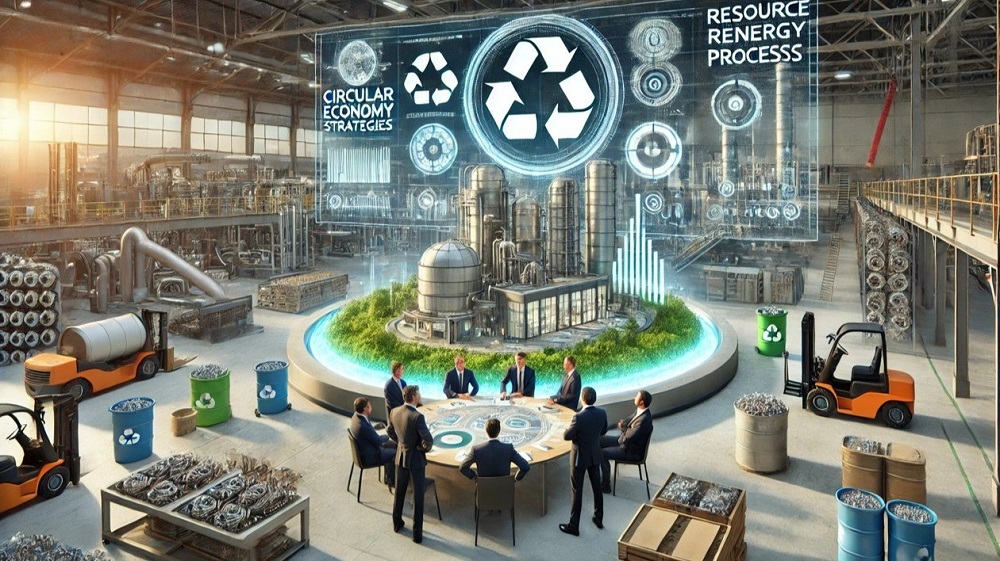
For over a century, the global industrial sector has operated on a linear economic model defined by a take, make, waste philosophy. In this traditional framework, raw materials are extracted from the earth, manufactured into consumer or industrial goods, used until obsolescence, and ultimately discarded into landfills or incinerators. While this linear approach fueled massive industrial expansion during the twentieth century, it has become highly unsustainable due to rapidly depleting natural resources, escalating raw material costs, and severe environmental pressures.
To secure long-term viability, modern industrial operations are undergoing a profound paradigm shift by transitioning toward a circular economy. A circular economy completely eliminates the concept of waste by design. In a circular framework, industrial operations function as closed-loop systems where products, components, and raw materials are systematically maintained, refurbished, remanufactured, and recycled. By decoupling industrial growth from finite resource consumption, circular practices are transforming factory floor workflows, supply chain logistics, product engineering philosophies, and corporate business models across the globe.
Redesigning Products for Longevity and Dematerialization
The transition to a circular economy begins long before a single machine is activated on an assembly line. It requires a fundamental shift in product engineering, moving away from planned obsolescence toward intentional longevity.
Design for Disassembly and Remanufacturing
In a traditional manufacturing setup, products are often sealed, glued, or welded together in a manner that makes it completely impossible to separate individual components without destroying them. Circular industrial operations utilize design for disassembly principles. Engineers purposefully build products using modular architectures, standardized fasteners, and smart joints.
This structural transparency allows a technician or an automated robotic arm to rapidly take a product apart at the end of its initial lifecycle. High-value components, such as microprocessors, electric motors, or hydraulic pumps, can then be extracted intact, cleaned, tested, and seamlessly integrated into brand-new products through professional remanufacturing. This process drastically reduces the energy and raw materials required to produce complex assemblies from scratch.
Material Substitution and Monomaterial Engineering
Traditional manufacturing frequently blends multiple distinct materials together, such as bonding plastic laminates to wood composites or creating intricate metallic alloys that are highly difficult to separate. These multi-material products are incredibly complex to recycle, routinely ending up in landfills.
Circular operations resolve this challenge by implementing monomaterial engineering, designing complex components out of a single material family that can be ground down and melted back into pure raw inputs without chemical contamination. Furthermore, industrial designers are systematically substituting toxic chemicals and rare-earth elements with bio-based, non-toxic, and infinitely recyclable alternatives to ensure that any inevitable material loss does not harm the biosphere.
Transforming Factory Operations and Waste Valorization
Within the physical boundaries of the manufacturing plant, circular practices are redefining how energy, water, and manufacturing scrap are managed, converting traditional cost centers into valuable revenue streams.
Implementing Industrial Symbiosis
Industrial symbiosis occurs when the waste streams, byproduct outputs, or residual energy of one industrial facility become the direct raw material inputs for an adjacent facility. Instead of operating in total isolation, modern factories are organizing into integrated eco-industrial parks.
For example, a chemical processing plant might capture its excess thermal heat and pipe it directly to a nearby commercial greenhouse or paper mill. Similarly, a steel manufacturing plant can capture its blast furnace slag byproduct and sell it directly to a concrete manufacturing company to replace raw mined aggregate. This collaborative network lowers carbon footprints, eliminates waste disposal fees, and stabilizes material supply lines for all participating parties.
Zero Waste to Landfill and Closed Loop Water Systems
Advanced manufacturing facilities are continuously auditing their internal operations to achieve absolute zero waste to landfill status. Advanced computer vision systems and automated sorting machinery capture metal shavings, plastic trims, and cardboard packaging directly on the production line, routing them instantly into local recycling pipelines.
Water-intensive industries, such as textile dyeing, microchip fabrication, and automotive painting, are installing sophisticated on-site membrane bioreactors and reverse osmosis systems. These advanced treatment systems allow a factory to continuously clarify and reuse its internal industrial wastewater in a closed loop, drastically reducing freshwater extraction and eliminating the discharge of industrial effluent into local ecosystems.
Shifting Business Models: Product as a Service
One of the most revolutionary changes driven by the circular economy is the complete restructuring of customer relationships and corporate ownership structures.
The Rise of the Product as a Service Model
In a standard linear model, a manufacturer maximizes its profitability by selling as many physical units as possible to customers, transferring all maintenance, disposal, and environmental liabilities to the buyer. In a circular economy, businesses are pivoting toward the Product as a Service model. Under this framework, the manufacturer retains absolute ownership of the physical asset throughout its entire lifecycle, while the customer merely rents or leases the operational utility of the machine.
This model is being successfully deployed across heavy industries:
-
Commercial Lighting: Aerospace and corporate facilities lease light as a service, where lighting manufacturers retain ownership of all fixtures, sensors, and LED bulbs, managing all maintenance and upgrading systems continuously.
-
Industrial Machinery: Compressed air systems, heavy construction equipment, and massive commercial HVAC units are increasingly billed based on actual run-time hours or operational outputs rather than sold outright.
-
Aviation Engines: Major aerospace manufacturers lease the operational hours of their jet turbines, taking total responsibility for predictive maintenance, parts replacement, and ultimate end-of-life recycling.
Aligning Corporate Incentives with Sustainability
When a manufacturer maintains ownership of its products indefinitely, its economic incentives shift dramatically. Under a traditional sales model, making a product that lasts too long reduces future replacement sales.
Under a service model, a product that breaks down introduces a massive maintenance expense that drains the manufacturer’s profit margins. Therefore, companies are economically motivated to build machines that are incredibly durable, energy-efficient, easy to repair, and simple to upgrade, aligning corporate profitability directly with resource conservation.
Reverse Logistics and Digital Material Passports
A circular loop cannot function without an efficient system to retrieve products once their initial operational cycle concludes. This requires a complete restructuring of global supply chain networks.
Building Complex Reverse Logistics Frameworks
Traditional supply chains are designed strictly for forward logistics, moving raw materials from a mine to a factory, a distribution center, a retail store, and a customer. Circular operations invest heavily in reverse logistics networks, establishing reliable take-back programs, localized collection hubs, and specialized disassembly centers.
By leveraging data-driven routing software and collaborating with third-party logistics firms, companies can coordinate the pickup of spent equipment during routine forward delivery runs, minimizing transportation emissions and lowering the cost of reclaiming valuable material assets.
Tracking Materials via Digital Passports
To recycle or remanufacture a product effectively, technicians must know its exact chemical and structural composition. Modern industrial operations are solving this information gap by implementing digital product passports.
Using quick response codes, radio frequency identification tags, or secure blockchain ledgers embedded directly onto individual components, a material passport tracks the complete history of an asset. It records the exact origin of raw materials, the specific chemical treatments applied during manufacturing, maintenance logs, and precise instructions for safe disassembly. This digital transparency ensures that down-cycle processors can sort and recycle high-performance materials safely and efficiently.
Frequently Asked Questions
What is the precise economic difference between traditional recycling and a circular economy?
Traditional recycling is typically a downstream reactive process that attempts to recover some value from a product after it has already reached the end of its linear lifespan, often resulting in down-cycling, where high-performance materials degrade into lower-quality products. A circular economy is a holistic, upstream systemic approach that designs out waste and pollution from the very beginning. It prioritizes keeping materials at their highest quality and utility through continuous loops of repair, reuse, refurbishment, and remanufacturing, reserving standard recycling as a final baseline option.
How do circular practices protect industrial manufacturers from global supply chain shocks?
Linear supply chains are highly vulnerable to geopolitical conflicts, localized trade embargoes, and the volatile price fluctuations of raw material markets. By utilizing circular economy practices, a manufacturer builds a reliable, internal secondary supply chain sourced directly from its own recovered products. Reclaiming metals, plastics, and electronics from existing equipment isolates the company from external material scarcity, lowers reliance on volatile international mining operations, and stabilizes long-term manufacturing input costs.
Can a circular economy approach be profitable for a small to mid-sized manufacturing facility?
Yes, small and mid-sized manufacturing facilities can successfully achieve high profitability through circular practices by starting with highly targeted internal initiatives. Smaller operations can focus on minimizing localized production scrap, entering into local industrial symbiosis agreements to sell their byproducts to nearby businesses, or offering regional repair and refurbishment services for their products. Because smaller firms are inherently agile, they can adapt their business workflows and test innovative service models far faster than massive global conglomerates.
What is biological circulation versus technical circulation within a circular framework?
The circular economy operates on two separate, distinct cycles known as the butterfly diagram. The biological cycle handles materials that can safely decompose and return to nature, such as agricultural waste, bio-based textiles, and biodegradable plastics. These items are managed through composting or anaerobic digestion to enrich local soils. The technical cycle manages finite materials that cannot safely return to nature, such as metals, advanced polymers, and electronic components. These items are strictly kept within synthetic industrial loops through continuous maintenance, reuse, and remanufacturing.
How does the implementation of digital twins support circular industrial workflows?
A digital twin is a highly detailed, virtual replica of a physical machine or component that updates in real time using sensor telemetry data. In circular operations, digital twins allow maintenance engineers to track the exact wear, stress levels, and operational hours of an individual machine remotely. This predictive visibility allows the company to replace a specific component right before it fails, preventing catastrophic damage to the rest of the machine and ensuring that individual parts are harvested for remanufacturing at their absolute optimal moment.
Why is chemical recycling considered an important innovation for circular plastics?
Traditional mechanical recycling involves sorting, washing, and melting plastics down, a process that damages the polymer chains and limits the number of times the plastic can be reused before losing structural integrity. Chemical recycling utilizes advanced thermal or chemical processes to break plastics back down into their fundamental molecular monomers. This process removes all dyes, additives, and contaminants, creating a pure virgin-grade chemical feedstock that can be used to manufacture high-performance plastics infinitely without any qualitative degradation.
What are the primary regulatory pressures pushing global industries toward circularity?
Governments worldwide are implementing strict regulations to accelerate the transition toward circular operations. Key legislative drivers include Extended Producer Responsibility mandates, which legally hold manufacturers financially and physically responsible for the entire post-consumer lifecycle of their products. Additionally, regulations such as right to repair laws, strict plastic taxes, mandatory minimum recycled content thresholds, and carbon border adjustment mechanisms are making linear operations increasingly expensive while financially incentivizing circular system development.